
Table of Contents
- Renter Friendly Wall Decor Ideas That Survive Move-Out Day
- No-Damage Wall Hanging Ideas: Adhesive Hooks, Strips, and Leaning Art
- How to Build a Renter-Friendly Gallery Wall Without Nails
- Temporary Wallpaper for Renters: Accent Walls and Peel-and-Stick Decals
- Renter-Friendly Floating Shelves and Other No-Drill Storage
- Removal Day: Getting Your Deposit Back Without Paint Damage
- Your Lease, Your Landlord, and What to Check First
- Conclusion: Start With One Wall
- Frequently Asked Questions
Last Updated: October 7, 2026
Renter Friendly Wall Decor Ideas That Survive Move-Out Day
Renter friendly wall decor is any wall treatment you can install and remove without drilling, spackling, or repainting before you hand back the keys.
You do not need a drill to make a room feel finished. This guide covers no-damage wall hanging ideas, gallery walls, temporary wallpaper, no-drill shelving, and clean removal on move-out day.
No-Damage Wall Hanging Ideas: Adhesive Hooks, Strips, and Leaning Art
Adhesive hooks and strips are the fastest no-damage wall hanging ideas for renters.
Weight is the number that matters. Every strip and hook lists a limit, stay well under it. Two strips hold a light frame, not a heavy mirror.
Leaning art skips adhesive entirely. Rest a framed print or mirror on a shelf, ledge, or the floor against the wall. It removes in one second.
A few rules we give every customer:
- Clean the wall with a dry cloth first. Dust kills grip.
- Press and hold for the full time on the packet, usually 30 seconds.
- Wait an hour before hanging anything.
Matching the Method to Your Wall Surface
Wall-surface compatibility decides which method works. Flat or satin paint in good shape takes adhesive well. Textured, glossy, or freshly painted walls often do not.
| Wall Surface | Best Method | Avoid |
|---|---|---|
| Smooth painted drywall | Adhesive strips and hooks | Nothing major |
| Fresh paint under 2 weeks | Leaning art, shelves | All adhesive |
| Textured or stippled | Leaning art, decals | Hooks and strips |
| Brick or concrete | Leaning art, freestanding pieces | Adhesive, most decals |
| Wallpaper | Leaning art only | Adhesive, decals |
Test one strip in a hidden spot before you commit a whole wall to it.
How to Build a Renter-Friendly Gallery Wall Without Nails
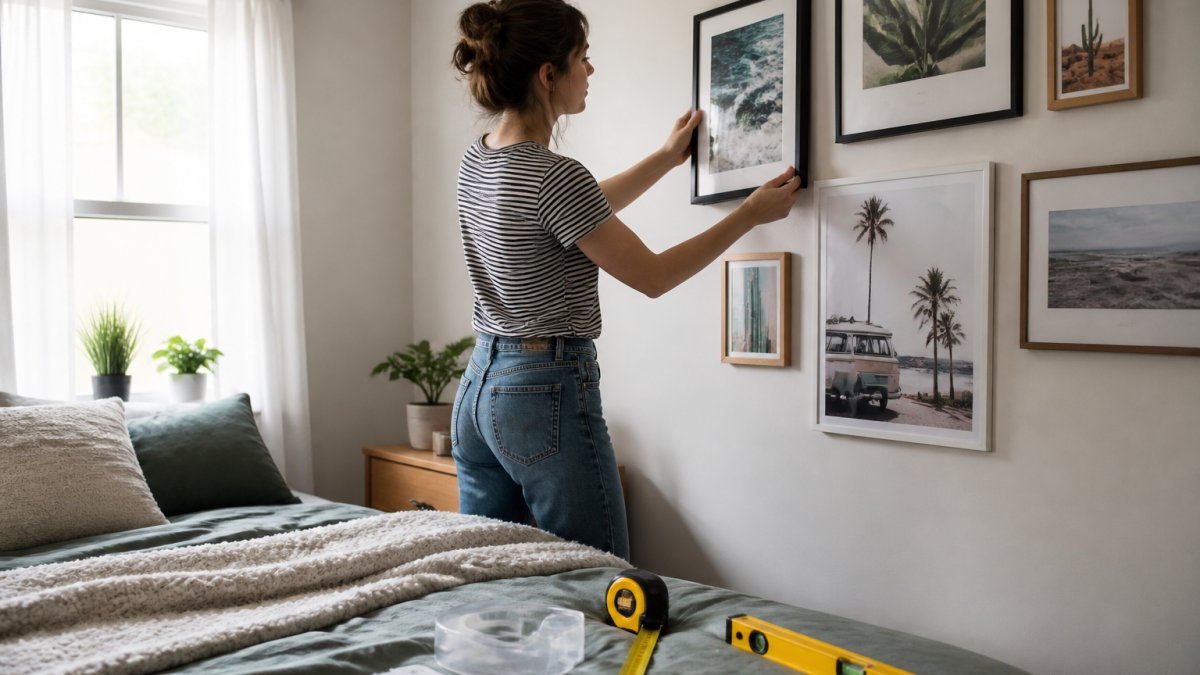
A renter-friendly gallery wall needs three things: a paper template, a level, and adhesive strips rated for the weight.
- Lay your frames on the floor and arrange them until the spacing looks right.
- Trace each frame onto paper and cut the shapes out.
- Tape the paper shapes to the wall with painter's tape.
- Step back and adjust before anything sticks.
- Mark the hanging point on each paper shape.
- Stick your adhesive strips, then press each frame into place.
- Hold each frame for 30 seconds and leave it alone for an hour.
The 3-5-7 Rule and Layout Tricks for Small Walls
The 3-5-7 rule means grouping frames in odd numbers: three, five, or seven. Odd counts look balanced without feeling stiff. On a small wall, keep the arrangement inside one imaginary rectangle, centered at eye level (roughly 145 cm from the floor), with 5-8 cm between frames.
Our Montana Vintage Travel Poster and Rainier National Park poster work well as the anchor piece in a gallery wall. They ship rolled, so they arrive flat and ready to frame.


Temporary Wallpaper for Renters: Accent Walls and Peel-and-Stick Decals
Temporary wallpaper is the highest-impact option on this list. A peel-and-stick roll can change a whole wall in an afternoon and lifts off when you move, but it is also the option most likely to cost you a deposit if you skip prep.
Pick the Right Wall Before You Pick the Paper
Peel-and-stick wallpaper bonds best to smooth, fully cured, satin or eggshell paint. It struggles on four surfaces:
- Fresh paint under about two weeks old. The paint is still curing and the adhesive can bond to the top layer instead of releasing from it.
- Flat or matte paint. Matte finishes are porous and tend to grab the adhesive, which raises the odds of peeling paint on removal.
- Textured or stippled walls. The paper cannot make full contact, so edges lift and bubbles form.
If you are not sure what you have, tape an offcut in a hidden spot, behind a door, inside a closet, or low behind furniture, leave it 48 hours, then remove it slowly and check the wall.
The Prep Steps That Decide Whether Removal Goes Cleanly
- Wash the wall with a damp cloth and let it dry completely. Dust and kitchen film are the two most common reasons wallpaper fails.
- Let fresh paint cure. Two weeks is the common minimum; longer is safer in humid rooms.
- Plan the layout on the floor first. Most rolls have a repeat pattern, so match seams before anything touches the wall.
- Overlap seams slightly and press them down with a felt-edged squeegee, working from the center out.
- Trim at the ceiling, baseboard, and corners with a fresh blade. Dull blades tear the paper and leave ragged edges that lift later.
Decals: The Lower-Risk Version
Removable decals are the lighter option. They add color and pattern without covering a full wall, come off in seconds, and are more forgiving on slightly textured surfaces because they are smaller and easier to press flat. The trade-off is scale, a decal reads as an accent, not a full accent wall.
Removal: Slow, Warm, and Low-Angle
Both wallpaper and decals need the same removal technique:
- Warm the surface with a hair dryer on low for 20-30 seconds. Heat softens the adhesive without cooking the paint.
- Start at a corner or seam and peel back at a low angle, close to parallel with the wall.
- Pull slowly and steadily, roughly 15 cm of stretch for every 2 cm of release. If the paper fights you, you are pulling too fast or too straight out.
- If residue stays behind, roll it off with a clean thumb rather than scraping.
- Wipe with a dry cloth. Skip harsh cleaners, which can dull the paint.
Renter-Friendly Floating Shelves and Other No-Drill Storage
Renter-friendly floating shelves come in two types: adhesive-mounted and freestanding. Both add storage and display space without a hole.
Adhesive shelves suit light loads only, small plants, candles, a couple of books. Keep the load well under the stated limit.
Corner Floating Wall Shelves Set of 4 | Wood Corner Shelves for Room & Home →
Our Corner Floating Wall Shelves Set of 4 are built for corners, which is dead space in most rentals. The set of four turns an empty corner into a spot for plants, photos, and small decor.

When adhesive is not an option, go freestanding. A freestanding bookshelf, leaning ladder shelf, or narrow console gives you the same storage with zero wall contact. Other no-drill options worth knowing:
- Decorative baskets hung on adhesive hooks
- Tapestries and fabric wall hangings on lightweight rods
- Corkboards for photos and notes
Removal Day: Getting Your Deposit Back Without Paint Damage
Residue-free removal is a technique, not luck. The biggest mistake renters make is pulling adhesive off fast and straight. Do this instead:
- Warm the adhesive with a hair dryer on low for 20-30 seconds.
- Pull the tab down and back, parallel to the wall, in a slow stretch, about 15 cm of stretch per 2 cm of release.
- If residue stays, roll it off with a clean thumb, then wipe with a dry cloth. Skip harsh cleaners.
Most paint damage comes from three things: pulling too fast, pulling at a right angle, or hanging on uncured paint. Fix those three and your walls come back clean.
Your Lease, Your Landlord, and What to Check First
Your lease is the final word on what you can hang. Read it before you buy anything. Most rental disputes over wall decor come down to one question: was the change reversible, or an alteration?
The Clause Checklist
Open your lease and search for these terms. Each tells you something specific about what you can and cannot do.
- "Alterations" or "modifications." This clause usually bans wallpaper, decals, and anything adhered to the wall. If alterations require written consent, assume adhesive wallpaper counts.
- "Wall damage" or "nail holes." Many leases allow small picture hooks but charge for patching, sometimes a per-hole fee at move-out. Read the number so you know what a mistake costs.
- "Move-out inspection" or "walkthrough." This tells you the process and timeline. If a joint inspection is required, schedule it, a walkthrough with the landlord present is the best chance to resolve disagreements on the spot.
Reversible Decor vs. Alteration
A useful rule of thumb: if removing it returns the wall to its prior condition with no tools, patching, or repainting, it is reversible decor. If removal leaves a mark, hole, or residue needing repair, it is an alteration.
| Your Plan | Usually Reversible | Usually an Alteration |
|---|---|---|
| Adhesive hooks under the rated weight | Yes | , |
| Leaning framed art on a shelf or floor | Yes | , |
| Freestanding shelves and bookcases | Yes | , |
| Peel-and-stick decals on cured paint | Usually | If paint lifts on removal |
| Peel-and-stick wallpaper | Sometimes | Often treated as an alteration |
| Nails, screws, or anchors | , | Yes |
| Painting the wall | , | Yes |
When in doubt, assume the stricter reading. Landlords rarely object to reversible decor; they frequently object to surprises at move-out.
How to Ask for Permission in Writing
If the lease is vague, ask your landlord in writing before you install anything.
Hi [name], I am planning to decorate my [room] wall with removable adhesive strips and peel-and-stick decals. I will remove everything before move-out and leave the wall in its original condition.
Three things make that email effective: it names the specific products, states the removal plan, and asks a yes-or-no question. Vague requests get vague answers.
What to Do If the Answer Is No
If your landlord says no to adhesive products, you still have options. Leaning art, freestanding shelves, floor mirrors, and textiles on tension rods do not touch the wall in a way that leaves a mark, they are furniture, not alterations.
Conclusion: Start With One Wall
The hardest part of decorating a rental is trusting it will come down cleanly. Start with one wall, one method, and one test strip. Once it lifts off without a mark, the rest of the room opens up.
Apply Your Vibe curates decor designed to work together, from wall art and posters to corner floating shelves and ambient lighting. Every piece is designed to help renters create a space that feels like theirs.
Frequently Asked Questions
How do you decorate walls as a renter without damaging them?
Stick to methods that leave no holes and lift cleanly. Removable adhesive hooks and strips carry most lightweight framed prints and posters, provided you stay under the stated weight limit. Leaning framed art or a statement mirror against the wall needs no fixings at all. For a bigger change, temporary wallpaper and removable decals peel away without touching the paint. Before anything goes up, wipe the wall with a dry cloth so dust does not weaken the adhesive, and test one strip in a hidden spot first.
Are adhesive hooks and strips safe for rental walls?
They are safe on most smooth, painted surfaces when you follow the instructions. Press the strip firmly for the full recommended time before hanging anything, and respect the weight limit printed on the pack. Skip them on freshly painted walls, wallpaper, or textured and dusty finishes, where they can pull at the surface. On removal, stretch the tab slowly straight down rather than pulling it out toward you, and the strip should release without lifting paint.
What are the best renter-friendly wall decor ideas for a small apartment?
In a small space, go vertical and keep the floor clear. A renter-friendly gallery wall of framed prints fills a blank wall without furniture. Corner floating shelves turn dead space into storage for plants and photos. A leaning mirror bounces light and makes the room feel bigger, while a tapestry or fabric wall hanging softens a large empty wall for very little money. Layer in greenery and a record wall or corkboard for personality, and keep the palette to two or three colors so the room reads cohesive rather than crowded.
How do you make a rental wall look good on a budget?
Start with what you already own: unframed posters, photos, and postcards can form a gallery wall for the price of adhesive strips. Rolled art prints are an affordable way to fill a large wall, and you can frame them later. Add cheap visual interest with paper fans, decorative baskets, and plant life. A single statement mirror or a leaning print does more than five small pieces scattered around. Buy a few pieces that share a color or theme rather than many random ones, and the wall looks intentional.