
Table of Contents
- Start With a Bedroom Color Palette That Works for You
- Pick Your Bedroom Style Direction Early
- How to Mix Patterns and Textures in a Bedroom Without Overwhelming the Space
- Layer Your Bedroom Lighting Ideas for Warmth and Function
- Small Bedroom Decor Ideas That Create a Cozy, Cohesive Retreat
- Coordinate Furniture, Wall Art, and Focal Points
- Common Beginner Mistakes and How to Avoid Them
- Your Cohesive Bedroom Decor Checklist and Next Steps
- Frequently Asked Questions
Last Updated: October 16, 2026
Start With a Bedroom Color Palette That Works for You
A cohesive bedroom decor starts with your color palette, the foundation for every piece you add. Warm tones like terracotta and mustard create coziness; cool tones like sage green feel peaceful; neutrals like white, gray, and beige work with almost anything.
Neutral Foundations and Accent Colors
Start with a neutral base, soft gray, warm white, or pale beige, for walls and large furniture, then add 1-2 accent colors that pop. The rule: one neutral, one or two accents. This keeps the room from feeling chaotic.
Popular Color Combinations for Beginners
Color combos that work well together:
- Warm and cozy: Cream walls + terracotta accents + wood tones
- Cool and calm: Soft gray walls + sage green accents + white bedding
- Modern neutral: Warm white walls + mustard accents + black details
Pick Your Bedroom Style Direction Early
Choosing your style early guides every purchase and prevents mismatched pieces.
Your style direction, minimalist, boho, or rustic, shapes your furniture, wall art, and decor accents.
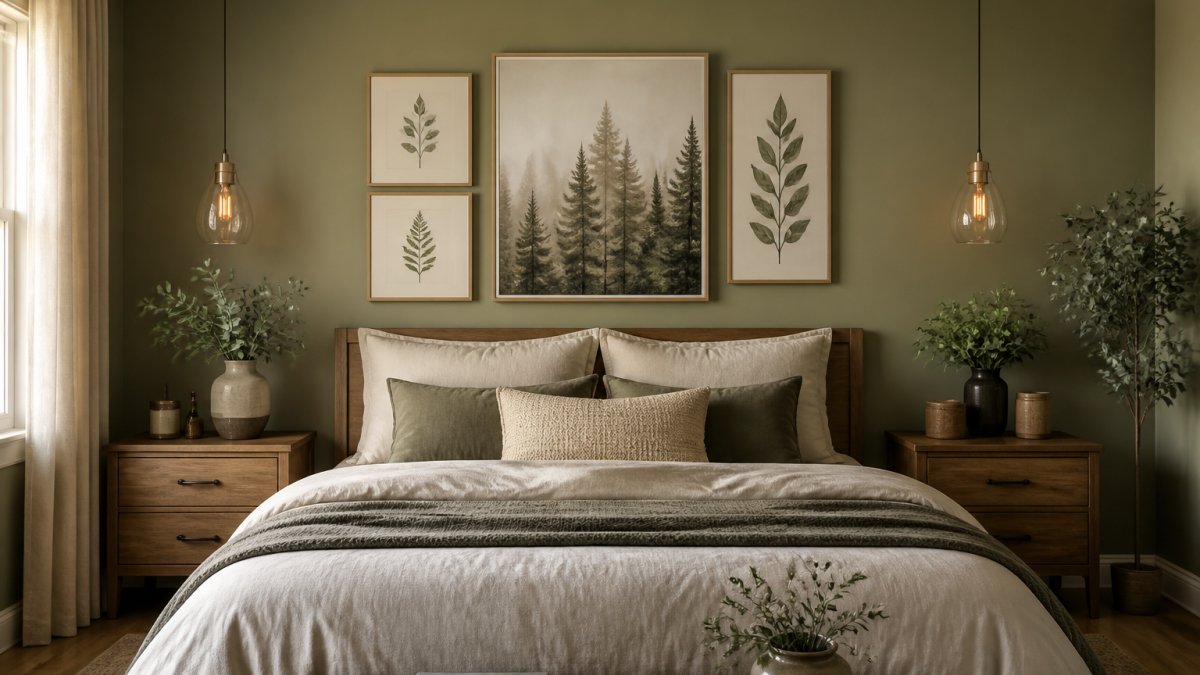
Common styles: minimalist (clean lines, simple colors), boho (layered textures, plants, warm tones), and rustic (wood furniture, neutral palette, cozy feel). Pick one and stick with it, then your furniture, color palette, and wall decor align into a cohesive space.
How to Mix Patterns and Textures in a Bedroom Without Overwhelming the Space
Patterns and textures add interest, but too many create chaos.
The Rule of Three for Patterns
Use no more than three patterns in your bedroom to keep things balanced and cohesive:
- Pattern 1: Your bedding (stripes, florals, or geometric shapes)
- Pattern 2: A throw pillow or second blanket
- Pattern 3: A small accent like a rug or wall hanging
Make sure your patterns share colors from your palette. A striped pillow should use your accent colors. A patterned rug should complement your bedding.
Layering Bedding and Soft Furnishings
Layered bedding creates warmth and texture: fitted sheet, flat sheet, comforter or duvet, then a throw blanket.
The Velvet Winter Throw-Blanket adds soft texture and visual interest to your bed.
Mix textures too, soft velvet with smooth cotton, a chunky knit blanket, for depth without chaos.
Layer Your Bedroom Lighting Ideas for Warmth and Function
Good lighting transforms a bedroom. Most bedrooms need three types of light.
Task, Ambient, and Accent Lighting
Task lighting helps you see clearly, bedside lamps for reading, a desk lamp for work.

The Energy Saving LED Bamboo Bedside Lamp provides warm task lighting with adjustable brightness.
Ambient lighting sets the mood via your overhead light or dimmer.
Consider the Indoor Sensing USB Charging Wall Lamp for ambient or accent lighting.
Small Bedroom Decor Ideas That Create a Cozy, Cohesive Retreat
Small bedrooms are a measurement problem, not a design problem. Know your dimensions and clearances, and decorating decisions get easier.
Start With a Simple Floor Plan and Real Measurements
Before you buy anything, measure the room. Write down wall lengths at the widest point, ceiling height (how tall a headboard or shelf can go before the room feels top-heavy), window and door positions including swing direction, and outlet and light switch locations.
Clearances and Furniture Scale That Actually Work
A few rules of thumb make a small bedroom feel intentional instead of cramped:
- Walking paths: leave roughly 24-30 inches between the bed and the wall or dresser.
- Bed placement: center the bed on the longest wall if possible; if not, tuck one side against a wall and use a single nightstand, a normal, cohesive choice.
- Nightstand height: the top should sit within a few inches of the mattress top.
If a dresser won't fit, a tall bookcase or wall-mounted shelf uses vertical space without blocking the floor.
Vertical Space Without Visual Clutter
Going up is the classic small-room move, but do it with restraint:
- One tall element per wall. A single tall shelf, tall mirror, or floor lamp, multiple tall pieces on the same wall fight each other.
- Hang curtains high and wide. Mount the rod close to the ceiling and extend it a few inches past the window frame on each side to make the window and room read as larger.
- Floating shelves hold small decor and keep the floor clear. Keep them to two or three, styled with books, a small plant, and one object matching your accent color.
Renter-Friendly Fixes That Still Feel Cohesive
Renters can create a pulled-together room without paint or permanent holes:
- Removable wallpaper on one accent wall behind the bed, in a pattern that includes at least one palette color.
- Command strips and adhesive hooks for lightweight art and mirrors, check the weight rating, which is usually lower than people expect.
- Peel-and-stick decals for a quick focal point, kept to one area so they don't read as clutter.
A Quick Small-Room Cohesion Check
Before you call the room done, run through this list:
- Does every piece fit your color palette (one neutral plus one or two accents)?
- Is there a clear walking path from the door to the bed?
- Is the rug large enough to sit under at least the front legs of the bed?
If you can answer yes to most of these, your small bedroom will read as cohesive even if it is not perfectly styled.
Coordinate Furniture, Wall Art, and Focal Points
Every bedroom needs a focal point, the main thing your eye lands on, to anchor your cohesive bedroom decor.
Choosing a Headboard as Your Anchor
Your bed is usually the largest piece, so make it your focal point. A headboard draws attention: wood fits rustic or boho, upholstered suits modern or minimalist, and even a fabric tapestry behind the bed creates a focal point. Style the area with wall art above, matching nightstands on either side, and warm lighting.
Building a Gallery Wall That Ties the Room Together
A gallery wall displays art, reflects your personality, and anchors your cohesive space.
The Rainier National Park Vintage Travel Poster works in many styles.
Lay pieces on the floor and photograph the layout before committing to holes.
Energy Saving LED Bamboo Bedside Lamp →
Keep it cohesive: art that shares your room's colors, one style, and not too many themes.
Common Beginner Mistakes and How to Avoid Them
Most beginner decorating problems are about sequence and scale, not taste. Here are the mistakes that show up again and again, with the fix that resolves them.
Mistake 1: Buying Decor Before Choosing a Palette
Why it happens: Color decisions feel abstract, so beginners skip them, but every object carries a color, and without a palette there's nothing to check it against.
The fix: Write your palette on a phone note, one neutral, one or two accents, and check every item against it.
Mistake 2: Mixing Too Many Styles Without a Bridge
What it looks like: A boho rattan chair, glossy modern dresser, and rustic wood bed, each fine alone, but the room feels confused.
Why it happens: Beginners buy what they like in the moment, and that often spans several styles.
The fix: Pick one style as the majority (roughly 70%) and let other pieces be accents (30%).
Mistake 3: Ignoring Scale and Clearance
What it looks like: A king bed in a 10x10 room, a nightstand six inches shorter than the mattress, a rug covering only the middle of the floor.
Why it happens: Furniture is bought online without measuring the room or checking dimensions.
The fix: Measure first, buy second.
Mistake 4: Too Many Patterns
What it looks like: Patterned wallpaper, bedding, curtains, and rug all in one room, the eye has nowhere to rest.
Why it happens: Each pattern looks good alone, and beginners add them one at a time without counting.
The fix: Cap patterns at three, sharing at least one palette color: one large-scale (bedding or rug), one medium (pillows or curtains), one small (a throw or accent pillow).
Mistake 5: Flat Lighting
What it looks like: One overhead light in the center of the ceiling, harsh or dim, with no mood at night.
Why it happens: Overhead lighting is the default, and beginners don't realize a bedroom needs layers.
The fix: Add at least two more sources: a bedside task lamp and one accent light (sconce, string lights, or small dresser lamp), using warm bulbs (around 2700K).
Mistake 6: The Room Feels Unfinished
What it looks like: All the big pieces are in place, but the room feels like a showroom, not a retreat.
Why it happens: Beginners stop after furniture and bedding, skipping the layers that add warmth: texture, art, and a rug.
The fix: Add one textured element (chunky knit throw, velvet pillow, woven basket), one piece of wall art with a palette color, and a rug large enough for the bed.

A Quick Troubleshooting Flow
If you're not sure what's wrong, run through this order:
- Squint at the room. What stands out first? That is usually the problem area.
- Check the palette. Do the large pieces (bed, rug, curtains) share a neutral and one accent?
- Check the scale. Does anything look too big or too small?
- Count the patterns. Are there more than three?
- Check the light. Is there more than one light source, and is it warm?
Most beginner rooms improve dramatically after fixing just one or two.
Your Cohesive Bedroom Decor Checklist and Next Steps
Here's your step-by-step plan to create a cohesive bedroom:
| Step | Action | Priority |
|---|---|---|
| 1 | Define your color palette (neutrals + accents) | High |
| 2 | Choose your bedroom style direction | High |
| 3 | Plan furniture layout and measure space | High |
| 4 | Select bedding and layer textures | Medium |
| 5 | Add task and ambient lighting | Medium |
| 6 | Create a focal point (headboard or gallery wall) | Medium |
| 7 | Add wall art and decor accents | Low |
| 8 | Evaluate and adjust for cohesion | Low |
Start with the high-priority items: your color palette and style direction guide everything else, and measuring before buying furniture prevents costly mistakes.
Add layers gradually, bedding and lighting first, then wall art and smaller decor, so you can see how pieces work together before committing.
At Apply Your Vibe, we believe your bedroom should feel like you. It's your personal retreat.
Frequently Asked Questions
How do I make my bedroom decor look cohesive?
Start by choosing a color palette with a neutral base and 1-2 accent colors. Pick a style direction (boho, minimalist, modern, etc.) and stick to it across furniture, bedding, wall art, and lighting. Repeat your chosen colors and textures throughout the room, if you use sage green in your bedding, echo it in curtains or wall art. Coordinate your lighting layers (bedside lamp, wall sconces, overhead light) in matching finishes like warm wood or matte black. The key is making intentional choices rather than mixing random pieces.
What is the easiest way to choose a bedroom color palette?
Pick one neutral base color (white, beige, gray, or soft taupe) for 60-70% of your room, walls, larger furniture, or bedding. Then choose 1-2 accent colors you love from nature: sage green, terracotta, mustard, soft blue, or blush. Use your accent colors in smaller pieces like pillows, throws, wall art, or a feature wall. Test paint colors or fabric swatches in your actual room lighting before committing. This three-color approach creates balance without feeling chaotic and works for any style.
How do I mix patterns and textures without making my bedroom feel busy?
Use the rule of three: limit yourself to three patterns maximum (like a striped pillow, geometric throw, and floral wall art). Keep patterns in the same color family so they feel intentional rather than random. Mix pattern scales, pair large geometric prints with small florals or stripes. Balance patterned pieces with solid textures: a velvet throw blanket, linen sheets, or a woven basket. Let solid colors do most of the heavy lifting, and use patterns as accents. This approach adds visual interest without overwhelming the space.
What should I decorate first in a bedroom?
Start with your color palette and style direction, these anchor every other decision. Next, choose or paint your walls, then select your bed frame or headboard as your focal point. Layer in bedding and pillows, which set the tone for comfort and style. Add lighting (bedside lamps or wall sconces) to create ambiance. Finally, add wall art, curtains, and smaller accents. This order ensures larger pieces work together before you commit to smaller details, saving money and preventing mismatches.
Creating a cohesive bedroom takes planning, but it's worth the effort. A well-designed bedroom becomes your sanctuary. It's a space that makes you feel calm, inspired, and at home. Start with your color palette, choose your style direction, and build from there. Shop Apply Your Vibe for curated decor pieces that work beautifully together, and get 10% off your first order when you subscribe to our new drops.